
23-24

Comfort and Joy

All the world’s a stage…but retired actress Joy has stage fright. When son Mitch proposes Christmas dinner with Gini’s rich Shaughnessy family, Joy’s coping strategy threatens to provide anything but comfort.

You can take the actor off the stage but… Joy can’t help seeking attention. Mitch is caught between his mother’s outlandish behaviour and his desire to impress Gini into a relationship. Gini’s image-conscious stepmom Marlie is desperate for a “normal” family celebration, while dad Ted, a forestry baron, is intent on suing Greenpeace. Waiting in the wings is Gini’s twin sister Poey, whose Skype calls are less than merry and bright.

As Marlie downs more eggnog and Joy begins to sense something familiar about Ted, not only the turkey gets taken apart. Social niceties begin to unravel. Could a more comfortable life in Shaughnessy be within Joy’s reach? Does fate play a role in our decisions, or is our behaviour a matter of conscience? Playwright David King brings us comfort and joy while posing some of life’s uncomfortable questions.

The late David King was known as a musician, and a prolific writer for radio, television, film and stage — especially for his award-winning plays The Garage Sale and Life Skills. A more recent work, Comfort and Joy is making its debut with this Mercury Players production under the direction of Mary Louise Phillips.

Warning: occasional strong language and adult themes, but no more offensive than you’ll find on evening TV. Recommended for ages 16+.

Cast: Lisa Read, Callum Hughes, Elizabeth Brimacombe, Debs Howard and Jake Robinson. Mary Louise Phillips directs; producer is Judy Buchanan for the Mercury Players Society.


23-24

The Gravitational Pull of Bernice Trimble

This powerful, heart-tugging, darkly funny play is about middle child Iris Trimble trying to hold it all together after her mother, Bernice, a lively, recently widowed sixty-five year old breaks the news that she has early onset Alzheimer’s. In an effort to cope with the stress, Iris makes her mother’s famous Everything-That-Is-Bad-For-You casserole, a childhood favourite. Her siblings, on the other hand, are on opposite sides of the spectrum: Sarah, the eldest, irately calls for a second opinion, while Peter, the youngest, seems completely unfazed. As for Bernice, she’s still as vivacious as ever, always up for a good laugh, and, most of all, ready to finally put herself first.   

Warning:  Mature Themes and Strong Language

23-24

The Female of the Species – Staged Reading

What is a staged reading?
A staged reading is theatre in its purest form. No set, no props, no (or little) costumes. The lights will not turn on and off. Actors interact and perform the story with scripts in front of them. Some stage directions will be read to help set the scene. The closest approximation would be listening to an audiobook that is all dialogue, or watching a radio play (with no sound effects). If you have ever seen video of the voice acting being recorded for your favorite animated film, it is akin to that.

The Female of the Species
Thirty years ago Margot Mason, pioneer of the 1970s Women’s Liberation movement and fearless academic, wrote her groundbreaking work and numerous best-sellers followed. Now she has writer’s block. Molly, an unannounced visitor and committed fan of Margot and her work, offers a potential solution – until Molly produces a gun and calmly informs Margot that she intends to kill her because she blames her for warping her mother’s mind and ruining her life with her hit book The Cerebral Vagina.

Joanna Murray-Smith’s deliciously wicked comedy deftly walks the tightrope between satire and farce proving the female of the species is not only deadlier, but funnier than the male.

This latest gem from the pen of one of Australia’s most outstanding playwrights was inspired by Germaine Greer’s experience of being held captive in her country house in Essex in 2000.

MARGOT MASON – sixtyish, impressive, a monster
MOLLY RIVERS – early twenties, bright
TESS THORNTON – late thirties, lost
BRYAN THORNTON –late thirties but very boyish and thick
FRANK – masculine man in his early thirties.
THEO REYNOLDS – sixties, dapper

This presentation is directed by Sylvia Swift
Presented at the Sands Funeral Chapel Reception Centre – Entrance is on Ypres St.
Admission by donation to the Mercury Players


Why perform a staged reading instead of a full production?
There are more stories to tell than any theatre could conceivably produce and each one has a cost associated with it. Staged readings allow audience members to experience more great stories at a lower cost to the theatre and the patron. Win-win!

22-23

Tempting Providence

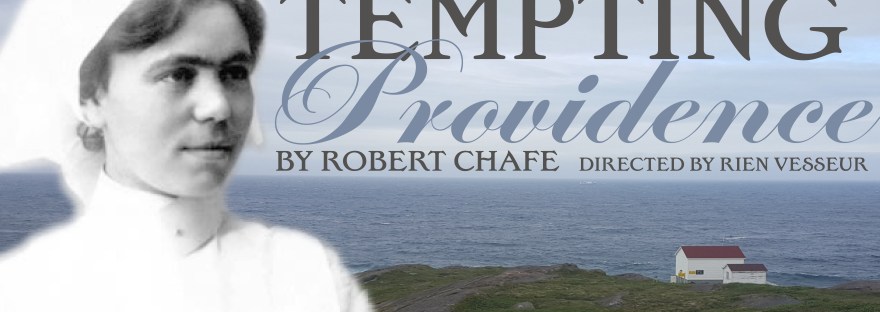
This magically inventive comedy-drama will transport you back to a time when people struggled, even harder than today, to survive. The nearest hospital was days away and forceful weather, disease, work accidents, malnutrition, and childbirth could claim your life quickly. You will meet the hard working people of Daniel’s Harbour, an outport with a vast roadless community, whom Nurse Bennett must serve. She travels by foot, boat or dogsled, depending on the season. Some of her patients are stubbornly superstitious, while others are willing to learn from “the Nurse.” From those in robust good health to those in dreadful pain, all possess the grit, courage and humanity to sustain themselves and their neighbours through extremely hard times. Tempting Providence explores Bennett’s steely British resolve but also humour and compassion for all those Newfoundlanders she comes to know and care for. At the core of the play is the love story between her and her pragmatic husband, Angus.

22-23

Mrs. Reynolds and the Ruffian

MERCURY PLAYERS SHOW ASKS:  CAN A BAD SEED EVER GROW?

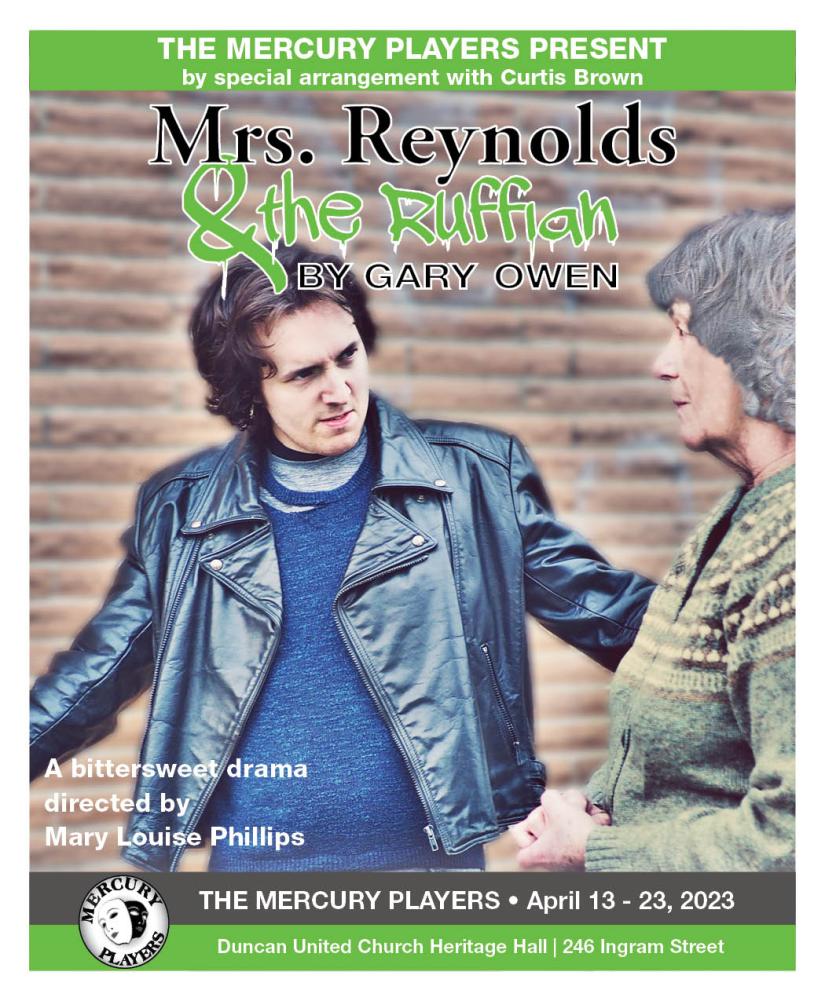
The Mercury Players are presenting Mrs. Reynolds and the Ruffian, a drama by Welsh Playwright Gary Owen , about a lonely but determined senior, trying to keep her neighbourhood clean and friendly, and the menacing young man who vandalizes her cherished garden and the local street.   When Mrs. Reynolds first agrees to let Jay (the Ruffian) work out his community “payback” by restoring her flowerbeds, there is much hostility on both sides.  However, human beings are complex and neither imagines the unlikely relationship that develops.

In a world where we often think only in tweets or headlines, Mrs. Reynolds and the Ruffian gives the audience an opportunity to look at the bigger picture and ask ourselves what happens when we try to break down barriers between people and get involved with each other’s struggles.  Is it worth it to try to help each other and improve the community?  It’s a story with hope.

Local actor Connor Lachmanec, who recently appeared with Shawnigan Players in The Crucible , plays the streetwise Jay, a troubled  youth who endured a  violent childhood.  Lachmanec sees the play  as “a universal story about redemption.  There’s a lot of intergenerational fighting nowadays.  So it’s cool to see the friendship between an older and younger person.  It’s also very relevant because, as the kids in the cast were telling us, there’s people doing (vandalism) like this -burning their high school bathrooms and stuff.  I think it resonates. “

While the play is a drama, there are lots of humorous moments too.  At a meeting with Mrs.  Reynolds, Jay scoffs to social worker, Cassie, (played by Julia Lalonde) “Where’d you get her, Antiques Roadshow?”

Also appearing in Mrs Reynolds and the Ruffian is Leslie Sanchez as Mrs. Reynolds, Dayna Corbett as Jay’s love interest, Mel, and  Cowichan Secondary School students Ella Dupuy and Presley Anderson, who play Jay’s delinquent pal, Kieran, at alternating performances.

Director, Mary Louise Phillips, states “For me personally, working with emerging talent from the school community is both a delight and an education.”  Phillips further remarks  ” …this play, with its young performers interpreting very contemporary adult themes, poses a challenge for them, for me, and the audience to explore new territory.”   

Warning:  Mrs. Reynolds and the Ruffian contains adult themes and strong language. May Not Be Suitable for All Ages

23-24

The Seventh Seal – Staged Reading

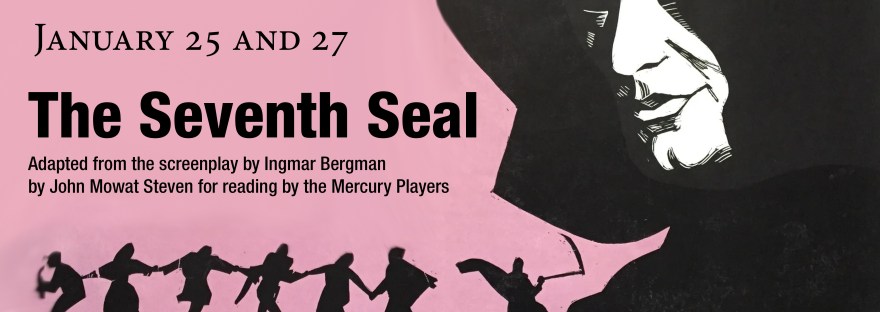
‘The Seventh Seal’, originally widely acclaimed as ‘one of the greatest films of all time’, was written by Ingmar Bergman, and has now been adapted for stage by Mercury Theatre’s own John Mowat Steven. Rob Foell directs the adaptation as a staged reading.

Personified Death comes to take the soul of an errant knight at the devastating height of the plague years of the Middle Ages. The knight challenges Death to a chess game, thereby buying time for himself and a variety of local citizenry to give today’s audiences some taste of what that daily struggle to survive those dark times entailed…ominously relevant to our own era of Covid, Climate Change, and social unrest.

PERFORMANCE DATES
Thursday, January 25 and Saturday, January 27 at 7:00pm
Details and registration at the bottom of this page.

What is a staged reading?
A staged reading is theatre in its purest form. No set, no props, no (or little) costumes. The lights will not turn on and off. Actors interact and perform the story with scripts in front of them. Some stage directions will be read to help set the scene. The closest approximation would be listening to an audiobook that is all dialogue, or watching a radio play (with no sound effects). If you have ever seen video of the voice acting being recorded for your favorite animated film, it is akin to that.

Why perform a staged reading instead of a full production?
There are more stories to tell than any theatre could conceivably produce and each one has a cost associated with it. Staged readings allow audience members to experience more great stories at a lower cost to the theatre and the patron. Win-win!

PERFORMANCE DATES
January 2024

23-24

Constellations – Staged Reading

Saturday, April 27, 2024
Presented at the Sands Funeral Chapel Reception Centre – Entrance is on Ypres St.
Admission at the door by donation to the Mercury Players.

Mercury Players’ third and final staged reading of the season is taking flight!

Roland (a bee keeper) and Marianne (a theoretical physicist) meet at a party. In that single moment, an unfathomable multitude of possibilities unfold. Their chance meeting might blossom into a meaningful relationship or a brief affair: it might lead to nothing at all. Each step along those possible paths in turn offers a new series of potential outcomes: a marriage can exist alongside a breakup and a tragic illness can exist on a parallel plane to a happily ever after. In this clever, eloquent and moving story, Roland and Marianne’s romance plays out over a myriad of possible lifetimes, capturing the extraordinary richness of being alive in the universe.

The staged reading of Constellations is directed by Adrian Ingham. Roland is read by Rien Vesseur and Marianne is read by Lisa Read.

What is a staged reading?
A staged reading is theatre in its purest form. No set, no props, no (or little) costumes. The lights will not turn on and off. Actors interact and perform the story with scripts in front of them. Some stage directions will be read to help set the scene. The closest approximation would be listening to an audiobook that is all dialogue, or watching a radio play (with no sound effects). If you have ever seen video of the voice acting being recorded for your favorite animated film, it is akin to that.

Why perform a staged reading instead of a full production?
There are more stories to tell than any theatre could conceivably produce and each one has a cost associated with it. Staged readings allow audience members to experience more great stories at a lower cost to the theatre and the patron. Win-win!

Uncategorized

Audition Notice


Canadian Wild Flowers
You are invited to audition for Mercury Players’ second production of the season:

Canadian Wild Flowers by Louise Phillips

Directed by Layne Kriwoken

Canadian Wild Flowers, set in Upper Canada 1865 to 1868, is based on a true story of one woman’s courage in meeting the challenges of poverty and loneliness as she finds a way to support her six children. She discovers the importance of family and of belief in her dream…and forever changes Canadian book publishing.

Cast

Doctor Roy, 25-40 (French-Canadian)
Susanna Moodie, 60s (English)
Agnes Moodie Fitzgibbon, 30s
Catharine Parr Traill, 60s (English)
Bridget, a servant, 18-25 (Irish)
Brown Chamberlin, late 30s
Lovell, a Publisher, 50s (Irish)
Ellis, a Printer, late 60s+ (English)
Maime Fitzgibbon, 14-17 Lives to write
James Fitzgibbon, 12-15 Brash, old for his years
Cherrie Fitzgibbon, 10-13 Outgoing, artistic
Alice Fitzgibbon, 7-10 High-spirited


Auditions: December 3, Wednesday evening and December 6, Saturday afternoon.

Rehearsals: Two nights and one weekend afternoon December (with a Holliday break) through to opening. The show runs Feb 20 – March 8: Friday and Saturday evenings, and Sunday matinees.

Stay tuned for more information or feel free to contact the director, layne.kriwoken@mercuryplayers.org

22-23

The Women of Lockerbie

On December 21, 1988 PanAm Flight 103  crashed onto a residential street in Lockerbie, Scotland. Seven years later “The Women of Lockerbie” are still struggling to come to terms with the fallout from the Lockerbie Bombing. This is a fictional play inspired by the Lockerbie Laundry Ladies who laundered the passengers’ clothing so that it could be returned to the families of the dead. The play is presented with a chorus in the Greek Style of Theatre at the Duncan Showroom, 133 Station Street.

Madeline and Bill travel from New Jersey to Lockerbie, Scotland. Madeline, played by Megan Bourns, is hoping to find some physical piece of evidence that her son died in Lockerbie. Adrian Ingham as Bill is trying to come to terms with “Why”. Why did his son die? Why can his wife not find closure? Why? After attending a vigil in the town Madeline and Bill roam the nearby hills struggling to make sense of the loss of their son. Near the creek that flows down the hillside they encounter “The Women of Lockerbie”. 

Shawnigan Players regular Jan Ovans is Olive, a spry senior who has come into conflict with the officious American George Jones. Olive and her friends want to take possession of stored clothing items so that they can be laundered and returned to the families. The Chorus is played by Lisa Read, Bethanny Brooks, Margie Pringle and Shauna Clinging. George, played by Dan Leckey, has been tasked with storage and disposal of all items that were held for the investigation of the bombing. Olive is aided by Hattie, the feisty cleaning lady at the storage facility played by Lori Appleton.

Director Sylvia Swift is excited to be working with the Greek Style of theatre where the chorus helps to clarify the story and connect with the audience. To quote a director of the play “Evil only triumphs when you allow it to. The best way to combat it, is with fierce love, great acts of kindness and strength of community.