23-24

Lesser Demons

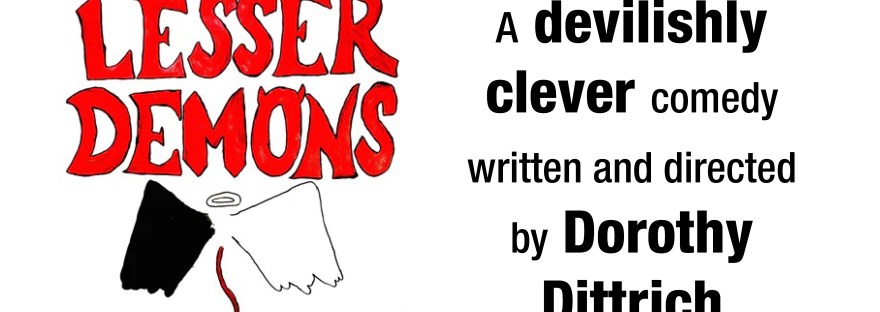
Join us at Heritage Hall at the Duncan United Church for Lesser Demons from May 2 – 5 and 9- 12. Thursday & Friday Evening performances at 7:30; Saturday and Sunday Matinees at 2:30

Lesser Demons, written and directed by Dorothy Dittrich, has a clever, funny and unusual plot. When Hannah agrees to a little weekend getaway to one of the Gulf Islands with her husband David, she has no idea what lies in wait. From past lives to deals with the devil, Lesser Demons takes a comic look at some serious subjects: family, love, creativity, forgiveness, spirituality and a few demons like ambition and greed along the way. 

The cast includes Mercury Players regulars Mary Louise Phillips, Sylvia Swift, Sara Kate Knight, Callum Hughes and Elizabeth Brimacombe. Newcomers to the Mercury stage are Layne Kriwoken, John Close and Karmin Mutter.

Playwright, musician and teacher, Nanaimo based Dorothy Dittrich won the 2022 Governor-General’s Literary Award for Drama with her script The Piano TeacherLesser Demons was a finalist for the recent Playwrights’ Guild of Canada comedy award. 
23-24

Tartuffe

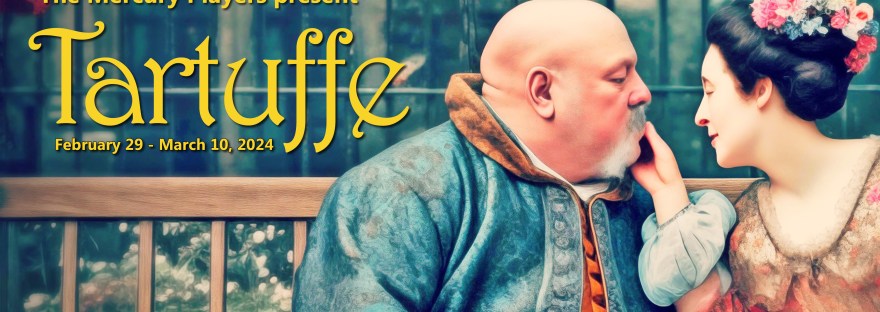
Mercury Players Society’s next production, Tartuffe is the most famous work by Molière,
the great 17th-century French satirist. Orgon’s family is up in arms because Orgon and
his mother have fallen under the influence of Tartuffe, a lecherous conman pretending to
be a pious spiritual adviser. Orgon and his mother no longer take any action without first
consulting him. Tartuffe’s antics do not fool the rest of the family or their friends; they
detest him. Orgon raises the stakes when he announces that Tartuffe will marry Orgon’s
daughter Mariane, who is already engaged to Valère. The plot becomes more and more
involved as it gallops to its surprising conclusion.


Deeper questions such as ‘What does it mean to be good?’ are carefully packaged into
a delightful farce with plenty of laugh-out-loud moments, a charming and quirky love
story and some tense moments for the Orgon family. Will he see the light? And if he
does, will it be too late?


Written entirely in rhyming couplets, this version of the great classic comedy, in
translation by Ranjit Bolt, is performed by a cast of 12 directed by Rien Vesseur.

23-24

Comfort and Joy

All the world’s a stage…but retired actress Joy has stage fright. When son Mitch proposes Christmas dinner with Gini’s rich Shaughnessy family, Joy’s coping strategy threatens to provide anything but comfort.

You can take the actor off the stage but… Joy can’t help seeking attention. Mitch is caught between his mother’s outlandish behaviour and his desire to impress Gini into a relationship. Gini’s image-conscious stepmom Marlie is desperate for a “normal” family celebration, while dad Ted, a forestry baron, is intent on suing Greenpeace. Waiting in the wings is Gini’s twin sister Poey, whose Skype calls are less than merry and bright.

As Marlie downs more eggnog and Joy begins to sense something familiar about Ted, not only the turkey gets taken apart. Social niceties begin to unravel. Could a more comfortable life in Shaughnessy be within Joy’s reach? Does fate play a role in our decisions, or is our behaviour a matter of conscience? Playwright David King brings us comfort and joy while posing some of life’s uncomfortable questions.

The late David King was known as a musician, and a prolific writer for radio, television, film and stage — especially for his award-winning plays The Garage Sale and Life Skills. A more recent work, Comfort and Joy is making its debut with this Mercury Players production under the direction of Mary Louise Phillips.

Warning: occasional strong language and adult themes, but no more offensive than you’ll find on evening TV. Recommended for ages 16+.

Cast: Lisa Read, Callum Hughes, Elizabeth Brimacombe, Debs Howard and Jake Robinson. Mary Louise Phillips directs; producer is Judy Buchanan for the Mercury Players Society.

23-24

The Gravitational Pull of Bernice Trimble

This powerful, heart-tugging, darkly funny play is about middle child Iris Trimble trying to hold it all together after her mother, Bernice, a lively, recently widowed sixty-five year old breaks the news that she has early onset Alzheimer’s. In an effort to cope with the stress, Iris makes her mother’s famous Everything-That-Is-Bad-For-You casserole, a childhood favourite. Her siblings, on the other hand, are on opposite sides of the spectrum: Sarah, the eldest, irately calls for a second opinion, while Peter, the youngest, seems completely unfazed. As for Bernice, she’s still as vivacious as ever, always up for a good laugh, and, most of all, ready to finally put herself first.   

Warning:  Mature Themes and Strong Language

23-24

The Female of the Species – Staged Reading

What is a staged reading?
A staged reading is theatre in its purest form. No set, no props, no (or little) costumes. The lights will not turn on and off. Actors interact and perform the story with scripts in front of them. Some stage directions will be read to help set the scene. The closest approximation would be listening to an audiobook that is all dialogue, or watching a radio play (with no sound effects). If you have ever seen video of the voice acting being recorded for your favorite animated film, it is akin to that.

The Female of the Species
Thirty years ago Margot Mason, pioneer of the 1970s Women’s Liberation movement and fearless academic, wrote her groundbreaking work and numerous best-sellers followed. Now she has writer’s block. Molly, an unannounced visitor and committed fan of Margot and her work, offers a potential solution – until Molly produces a gun and calmly informs Margot that she intends to kill her because she blames her for warping her mother’s mind and ruining her life with her hit book The Cerebral Vagina.

Joanna Murray-Smith’s deliciously wicked comedy deftly walks the tightrope between satire and farce proving the female of the species is not only deadlier, but funnier than the male.

This latest gem from the pen of one of Australia’s most outstanding playwrights was inspired by Germaine Greer’s experience of being held captive in her country house in Essex in 2000.

MARGOT MASON – sixtyish, impressive, a monster
MOLLY RIVERS – early twenties, bright
TESS THORNTON – late thirties, lost
BRYAN THORNTON –late thirties but very boyish and thick
FRANK – masculine man in his early thirties.
THEO REYNOLDS – sixties, dapper

This presentation is directed by Sylvia Swift
Presented at the Sands Funeral Chapel Reception Centre – Entrance is on Ypres St.
Admission by donation to the Mercury Players


Why perform a staged reading instead of a full production?
There are more stories to tell than any theatre could conceivably produce and each one has a cost associated with it. Staged readings allow audience members to experience more great stories at a lower cost to the theatre and the patron. Win-win!

23-24

The Seventh Seal – Staged Reading

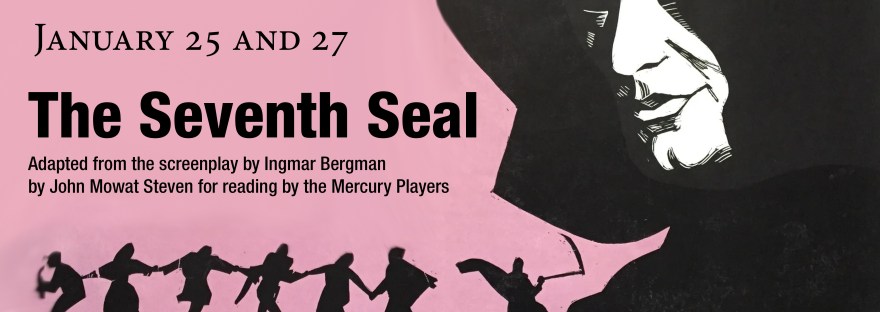
‘The Seventh Seal’, originally widely acclaimed as ‘one of the greatest films of all time’, was written by Ingmar Bergman, and has now been adapted for stage by Mercury Theatre’s own John Mowat Steven. Rob Foell directs the adaptation as a staged reading.

Personified Death comes to take the soul of an errant knight at the devastating height of the plague years of the Middle Ages. The knight challenges Death to a chess game, thereby buying time for himself and a variety of local citizenry to give today’s audiences some taste of what that daily struggle to survive those dark times entailed…ominously relevant to our own era of Covid, Climate Change, and social unrest.

PERFORMANCE DATES
Thursday, January 25 and Saturday, January 27 at 7:00pm
Details and registration at the bottom of this page.

What is a staged reading?
A staged reading is theatre in its purest form. No set, no props, no (or little) costumes. The lights will not turn on and off. Actors interact and perform the story with scripts in front of them. Some stage directions will be read to help set the scene. The closest approximation would be listening to an audiobook that is all dialogue, or watching a radio play (with no sound effects). If you have ever seen video of the voice acting being recorded for your favorite animated film, it is akin to that.

Why perform a staged reading instead of a full production?
There are more stories to tell than any theatre could conceivably produce and each one has a cost associated with it. Staged readings allow audience members to experience more great stories at a lower cost to the theatre and the patron. Win-win!

PERFORMANCE DATES
January 2024

23-24

Constellations – Staged Reading

Saturday, April 27, 2024
Presented at the Sands Funeral Chapel Reception Centre – Entrance is on Ypres St.
Admission at the door by donation to the Mercury Players.

Mercury Players’ third and final staged reading of the season is taking flight!

Roland (a bee keeper) and Marianne (a theoretical physicist) meet at a party. In that single moment, an unfathomable multitude of possibilities unfold. Their chance meeting might blossom into a meaningful relationship or a brief affair: it might lead to nothing at all. Each step along those possible paths in turn offers a new series of potential outcomes: a marriage can exist alongside a breakup and a tragic illness can exist on a parallel plane to a happily ever after. In this clever, eloquent and moving story, Roland and Marianne’s romance plays out over a myriad of possible lifetimes, capturing the extraordinary richness of being alive in the universe.

The staged reading of Constellations is directed by Adrian Ingham. Roland is read by Rien Vesseur and Marianne is read by Lisa Read.

What is a staged reading?
A staged reading is theatre in its purest form. No set, no props, no (or little) costumes. The lights will not turn on and off. Actors interact and perform the story with scripts in front of them. Some stage directions will be read to help set the scene. The closest approximation would be listening to an audiobook that is all dialogue, or watching a radio play (with no sound effects). If you have ever seen video of the voice acting being recorded for your favorite animated film, it is akin to that.

Why perform a staged reading instead of a full production?
There are more stories to tell than any theatre could conceivably produce and each one has a cost associated with it. Staged readings allow audience members to experience more great stories at a lower cost to the theatre and the patron. Win-win!